The Atlanta Botanical Garden is having its annual Spring Blooms event. At the end of winter, gardeners plant spring bulbs around the property, and, over the course of the spring, thousands of flowers appear.
Here’s a field of spring flowers in front of the plant conservatorySo many tulips! These are extra-tall…
The primary focus is on tulips, and this year, 200,000 tulip bulbs were planted. Tulips come in a wide range of colors, shapes and sizes, and there are many varieties growing in the garden right now. Colors range from whites and yellows to pinks and reds to deep purples. Some flowers are a single solid color, and some are striped. Some tulips have just a few petals, and some have a cluster of two or three dozen. Some petals have smooth edges, and some are frilly.
You can see variations in colors, and the pink flowers in the background have stripesThese rosy tulips have lots of petalsA field of colors
The garden staff does a great job of creating a variety of color palettes throughout the garden. Tulips are mixed with daffodils, hyacinths, jonquils and other flowers to provide a multi-colored tapestry with a variety of heights, shapes, and textures. Overall, the Spring Blooms event is always impressive.
A mix of flowersAn interesting mix of colors, textures, and sizesA field of colors
Another springtime garden event is Orchid Daze. The garden has a premier orchid collection as well as programs focused on orchid research and conservation around the world. While the Orchid Daze lasts for a few weeks in the spring and features some special events like Vanilla Sunday (natural vanilla comes from the cured seed pod of the Vanilla planifolia orchid plant), the Orchid Display House is open year-round and focuses on orchids that grow in tropical regions from sea level to 4,000 feet elevation.
Orchids on display in the plant conservatoryMore orchids on temporary display
Just like tulips, orchids come in all kinds of shapes, colors, and sizes. Some grow harmlessly on other plants, some grow on rocks, and some grow in soil. It’s always fun to wander through the orchid house and take in the variety of plants.
Some pretty orchidsAnd here’s another type of orchidOrchids in a hanging basketIt’s hard to believe that these flowers are all related when they have so much variation
Stay tuned for another post later this year where I’ll dive into more about the features of the Atlanta Botanical Garden.
There are some interesting transportation options in Atlanta these days.
There’s always the Marta train which is helpful for getting to certain locations around the city. The train system was built in 1979 with a north-south axis and an east-west axis. If you want to go somewhere on an axis, it’s helpful. If you want to go somewhere between the axis legs, it’s rubbish. Luckily for me, we live within walking distance of a Marta train station (we did that on purpose) and I work within walking distance of a train station. This makes it easy for me to take the train to work if it’s raining or if I’m just feeling lazy and don’t want to walk to work.
Uber and Lyft are convenient options if you want a more direct trip. Uber arrived in Atlanta in 2014 and was, by and far, a much better option than the local taxi service. Uber was great in the beginning, but I found that the service degraded over time as I started getting dirty, run-down cars when the gig economy took off. Lyft is generally better and cheaper (but does anyone else remember the giant pink moustaches from the early Lyft days?).
Atlanta used to have Zipcar and City Carshare. I used this service a lot. For example, I would take Marta to work and then use Zipcar to go to a doctor appointment in the middle of the day. I think Uber killed this.
For a while there was a bike-share program. Bikes were located around the city and you could use an app to check one out. And then scooters came along.
The scooter craze hit Atlanta in 2018 when thousands of these things were dropped around the city. This was a big mess with scooters all over the place, blocking sidewalks. It was as if cicada carcasses had fallen out of the sky all over the city. Scooters reigned supreme, and people were riding them EVERYWHERE, until Covid.
A scooter available via an app
Flash forward to today.
Scooters are still around. I don’t see people using them as much, but they are still used. The scooter companies now have bikes.
Scooters and bikes ready for use on the Beltline
But here’s the best part. Atlanta now has delivery robots and driverless cars.
The delivery robots are from Serve Robotics and are used for food delivery through Uber Eats and Doordash. I see them all over the place in downtown Atlanta because Georgia State University has its main campus buildings here, and there are tons of restaurants that do take-out for students. I also see these cute bots closer to my house in Old Fourth Ward along the beltline.
Every robot travels on sidewalks, waits patiently at red lights, uses the crosswalks, and pauses to let humans pass by. Each robot also has a unique name, which makes these little guys seem like adorable pets.
This little guy’s name is Maral
Driverless cars also arrived in Atlanta last year. These cars are by Waymo, and every one is a white Jaguar sedan with loads of navigation cameras. They are available through Uber, which might be the smartest thing Uber has done in a long time. The cars are much safer than human-driven cars, because they obey all traffic rules, they don’t drink and drive, they don’t text, they pay attention to pedestrians crossing the street, etc. After some of my experiences with Uber drivers, I would totally take a Waymo instead of a human driver.
The Waymo cars have lots of navigation camerasThe Waymo cars have lots of navigation cameras
Despite a cold snap earlier this week, it’s finally springtime in Atlanta. This is my favorite time of year. The days grow longer, and the weather warms up. Trees are pushing out new leaves and spring flowers are blooming, adding splashes of color everywhere after the dullness of the winter. For my walking commute to work, I no longer need to wear my winter layers of clothes in the morning, but it’s not yet the height of summer weather that leaves me overheated and dripping with sweat as I walk home in the afternoon.
The park across the street from my office is full of flowersTulips near my office
The birds are waking up earlier, sometimes a little too early, tweeting at 4:30 am. We’re seeing lots of fat robins flitting from tree to tree and hopping around the yard. Each spring, we typically get a nest somewhere in the yard with three or four eggs. Our little pond provides a resource for all kinds of birds throughout the year, and we’re continuing to see activity as birds take advantage of this water feature to have a drink of water or take a bath.
I saw this fat robin in our yard yesterday
There are tons of flowers blooming around our neighborhood with a variety of colors and sizes.
A mix of plantings in a neighbor’s yardPink azaleas on a bushTiny blue flowers along a street curbI don’t know what these flowers are, but I sure like them – this neighbor’s yard also has a variety of this flower in yellow and pinkLittle orange flowersHere are some flowers along a neighbor’s retaining wallMore flowers on another neighbor’s retaining wallFlowering vines a couple of doors down from our houseMore flowering vines at the end of the block
There are also lots of flowering trees right now. Common trees are dogwoods, redbuds, and cherry trees.
Dogwood trees look so light and lacy when they are bloomingA dogwood tree in bloomDogwood flowers are so interesting and uniqueOur neighbor across the street has a huge redbud tree – this photo is me standing on the sidewalk and looking up into the branchesRedbuds fascinate me – the flowers will bloom along the length of the branches and not just at the endsWe have a weeping redbud tree in our front yardWe also have cherry trees in our yardIn a week or two, the cherry trees will drop all of their petals as you can see in this photo from a couple of years ago, and our yard will look like someone just had a weddingCherry tree petals from last yearAnd let’s not forget trees that don’t flower but have new leaves, like these colorful new leaves along our sidewalkWe also have a weeping Japanese maple tree on the front sidewalkA full bed of cast iron plant
Spring marks the beginning of festival season in Atlanta. Beginning in spring and running through the fall, there are a variety of festivals in neighborhoods and parks all over the city. One of my plans this year is to go to all of the major festivals. Some of them will be old favorites like the Inman Park Festival in our own neighborhood, and some of them will be new experiences.
Artist booths during Inman Park Festival last yearThe annual Inman Park Festival parade starts in front of our houseEvery year, a group of gnomes marches in the parade during Inman Park Festival
Spring also signals the end of the school year, and even though we don’t have kids, I still feel the change in the rhythm of the calendar. At the end of May, we’ll stop hearing the school bus picking up kids in front of our house at 6:57 am and dropping them off at 2:35 pm during the week. My church handbell choir will pause rehearsals for three months which will free up my Wednesday evenings. The neighborhood pool behind our house will open up for the summer, giving Chad and me a place to cool off and relax together after a long day of work. And just in general, there’s a mental shift as we look forward to a change of pace – that sense of free time and long days of summer.
Ponce City Market is a mixed-use development next to the Beltline in the center of Atlanta. The Beltline is a 22-mile hike and bike path that circles Atlanta, and its construction over the last several years has led to an explosion in real estate development along its perimeter, including the development of Ponce City Market.
A view of the Beltline near our houseThe Beltline closer to Ponce City Market
The original brick building of Ponce City Market was built in 1926 to be the southeast headquarters for Sears Roebuck and Company, and it was occupied by the company until 1987. At the time, it was the largest brick building east of the Mississippi River. It housed company offices, a retail store, and the catalog warehouse.
View of Ponce City Market from Ponce de Leon AvenueView of Ponce City Market from the back sideYou can still see the old Sears Roebuck sign on the front of the buildingOne of the original entrances to the Sears retail store in 1926
From 1990-2010, the City of Atlanta housed part of its city hall function here. When we moved to Atlanta in 2009, people talked about City Hall East, referring to this building. The City sold the building to Jamestown, a developer, in 2011. In about 2012, Jamestown began construction to turn the building into a mixed-use development with restaurants, retail, office space, and apartments, and the redevelopment opened in 2014.
A bird’s-eye view of Ponce City Market – the large brick building is the former Sears Roebuck building, and to the right you can see the new office building with the green roof and the Scout hotel behind it, the new Signal House apartment building isn’t shown here, but it is to the left of the brick building and sits on top of the concrete parking deck at the back corner of the property, the Beltline runs along the left side of the property
Chad and I were able to take a tour during construction, and we learned some interesting facts. One of the most interesting things is that, for the offices and apartments, you are able to drive your car up to your floor and park next to your office/apartment. During the Jamestown renovation of the property, the structural engineer didn’t have to fortify the upper floors to support the weight of the cars that would park there, because the floors were already designed to warehouse Sears catalogues. Can you imagine? As an architect, that little fact has stuck with me for 14 years, even though I haven’t seen it published anywhere.
The building is connected to the Beltline via a pedestrian bridgeThere is a pedestrian entrance into the building from the BeltlineThe pedestrian entrance has fun murals as it goes past the parking garageThe pedestrian entrance continues on a boardwalk over a vegetated roof
The adaptive reuse of the building from a warehouse-type of place to a modern mixed-use is pretty interesting. The ground floor and second floor contain a wonderful food hall and retail tenants. The upper eight or so floors are offices and apartments.
One of the old freight elevators is now locked in place at the ground floor and serves as one of the main entrancesA central atrium connects the two levels of the food hallWhen the second floor was cut back to create the atrium opening, the orange beams were added to stabilize the floor slab and the concrete columnsBalcony seating on the second floor look down into the atriumDecorative spiral stairs connect the two levels of the food hall
The fun murals and graphic design elements are carried throughout the development and used for signage as well as general decoration.
One of the stairs to the rooftop boardwalk that connects to the BeltlineDirectional signageRestroom markers
One of the old freight elevators is still functioning, and it carries people up to the roof deck. The roof deck is open to the public, and it has an amusement park, a bar, and a great restaurant.
Waiting for the elevator to the roofThere’s a mini-golf courseThere are several boardwalk amusement park gamesThere’s a rooftop bar with great views across AtlantaAnd there’s a giant slide – I’m the one in the middle
In addition to having this development as an amenity in central Atlanta (I can walk to it, by the way), I have also contributed to the design of Ponce City Market. Gensler designed the Jamestown office in the building, and I was the sustainability lead for that project ensuring that the best materials, energy efficiency, and human health aspects were included in the design through LEED.
The reception area of the Jamestown officeView of the Jamestown office floorThe conference room area in the Jamestown office
During my time at Integral Engineering, I was the project manager and sustainability lead for the next three buildings on the property – an apartment building, a hotel, and a retail/office building, all of which are LEED certified.
The high-rise apartment building called Signal House is right on the Beltline. The apartments are pretty pricey – $2,400 for a one-bedroom, $3,100-$3700 for a 2-bedroom, and $4,300 for a 3-bedroom. However, the building is in a prime location, and amenities include a pool on an upper deck, a rooftop community garden, fitness room, clubhouse lounge, and concierge services.
View of Signal House from the BeltlineView of Signal House from the other side
The Scout hotel is interesting. It has regular hotel rooms, but it also has extended stay mini-apartments. It was quite the challenge to design these little apartments to feel luxurious while using minimal square footage. Like Signal House, the building has a rooftop pool and concierge service in addition to the regular hotel housekeeping services. The ground floor has retail spaces that can be leased and built out to be shops and/or restaurants.
The Scout hotel has short-term hotel rooms and extended-stay apartmentsThere are spaces for retail shops and restaurants on the ground level
The third building that I worked on, and probably the most interesting one, is the retail/office building. Pottery Barn has moved into the ground floor retail space, and there is office space for lease on the floors above.
The office building with Scout hotel in the backgroundThere is a shaded courtyard between the hotel and the office building
The building is all wood structure (columns, beams, floors) which is common in Europe but is highly unusual in the United States. Wood construction has a much lower carbon footprint than steel and concrete, and one of the primary goals of the overall development is to reduce its carbon footprint.
The design of the Pottery Barn store leaves the wooden structure exposed to viewAnother view inside Pottery BarnHere’s a rendering of office space above
Other design decisions to reduce carbon footprint across the development includes not having gas service on the site. This means that all of the apartment kitchens plus the future restaurant kitchens will be all-electric; there will not be gas stoves or gas water heaters. This is a fairly novel idea, especially for Georgia, and it was great to be part of the team that designed these cutting edge projects.
This weekend was the biennial Flower Show at the Atlanta Botanical Garden. Since this year is the 50th anniversary of the garden, the theme of the flower show was Heirlooms, and the show featured exceptional creations. We had been to the show in 2024, so it was fun to go again and see the new creations on exhibit.
The show was divided into four primary types of art – Floral Design, Horticulture, Photography and Botanical Arts. Within each of these divisions were judged competitions, and the awards for First Place, Second Place, and Honorable Mention were displayed next to the entries.
The Floral Design division was probably the most interesting one. Each entry used flowers to create a work of art. The division was divided into six categories – Vintage Illustrations, Chapeaux de l’Epoque, Portraitures, Art on the Grounds, Keepsake China, and Time-Honored Anniversary Gifts.
The Chapeaux de l’Epoque category featured hat styles from different decades.
Chapeaux de l’Epoque, 1900s Edwardian – First PlaceChapeaux de l’Epoque, 1900s Edwardian – First PlaceChapeaux de l’Epoque, 1880s Gilded AgeChapeaux de l’Epoque, 1920s Roaring 20sChapeaux de l’Epoque, 1960s HippieChapeaux de l’Epoque, 1970s Groovy
The Portraitures category featured bouquets that were inspired by portraits of women who made important contributions to the botanical garden over the years. Dorothy Chapman Fuqua and her husband donated the money to build the greenhouse conservatory on the property and provided the foundation for the garden’s orchid center.
Dorothy Chapman FuquaBouquet inspired by the portrait
Margaret Sheffield Martin was an influential member of the garden’s Board of Directors in the 1980s.
Margaret Sheffield MartinBouquet inspired by the portrait
The Art on the Grounds category showcased floral pieces inspired by art objects located around the garden.
A peacock with a photo of the inspiration, wire bird sculpturesBouquet inspired by a Dale Chihuly fountainThe fountain is right outside the exhibit hall
The category of Keepsake China showed designs interpreting china or pottery. Each of the entries was displayed in a box.
This one got second placeI thought this one was funThe mirrors on this one reflected the colors from all sides
In the category of Time-Honored Anniversary Gifts, this one represented Silver:
Silver Anniversary
The Horticulture division showcased plants that had been cultivated by home gardeners, and they were divided into two categories – Cut Specimens and Container-Grown Plants. Each subcategory was further divided into a series of classes such as annuals and biennials, perennials, flowering containers, foliage containers. There were a total of 41 classes across the two categories.
This plant was Best in Show for the whole Horticulture DivisionThe leaves were very interesting on this plantOther container-grown plants, the maidenhair fern (top right) got second place
Some of the cut flower entries:
One subcategory was Cut Collection in an Heirloom Container:
There was a category called Collection of Three Flowering Geophytes:
The entries weren’t limited to flowers.
Conifers
The Photography division had some interesting photographs on display. Flowers weren’t required to be included in every entry; it depended on the category in which the photo was entered – Estate Sale, Heirloom Stories, Beauty Never Fades, Whispers of the Past, A Moment in Time, Tools of the Trade, Jubilee, and Moving Forward by Reinterpreting the Past.
Each entry in the Estate Sale category was a composed still life, plant material not required but suggested.
This was my favorite – I loved the simplicity and the used of colorThis photograph had a lot of interest and detail, a nod to a classic still lifeThis entry shows items that were either made by or were a gift from the photographer’s grandmother
Heirloom Stories featured close-up photographs of heirloom plants.
This first place winner also won other awardsI loved this one
Whispers of the Past show images of a single bloom in an antique vessel.
The first place winnerI thought it was an interesting twist to put the flower in a bowl instead of a vase
A Moment in Time included images of a statue or monument from years past.
I like this delicate use of colorThe tomb of the founder of Ballet Russe
Tools of the Trade – photos of garden tools.
First placeI like this dynamic composition
Jubilee depicted images of celebration.
Arc de Triomphe, ParisNewlyweds
Moving Forward by Reinterpreting the Past was very interesting. Each photographer had to take a photo of a bird and then use post-editing techniques to mimic an Audubon print.
PelicansCan you believe this image started as an actual photograph?
The final division was Botanical Arts. In this group, artists created objects with dried flowers, leaves, and seeds in the categories of A Lady’s Ring, A Gentleman’s Pocket Watch, A Child’s Keepsake Box, A Christening Bonnet, A Jack in the Box, and A Cherished Heirloom Seed. I didn’t get any photos of these entries because, quite frankly, I didn’t find them very compelling.
As you can see, with the exception of the Horticulture division, each division had themes of the past, memories, time. The show and its exhibits were a great way to pay tribute to the 50-year history of the Atlanta Botanical Garden.
Today is John Lewis’ birthday. He was born in Pike County, Alabama on February 21, 1940. When he was growing up, his mom told him to stay out of trouble. He took that to heart, and throughout his life, he only got into what he called “good trouble.”
Mr. Lewis was a civil rights activist and one of the heroes of the Civil Rights Movement. He started his activist career while he was a college student in Nashville. His first arrest (of nearly 50 during his life) was at the Woolworths where he and other black students were peacefully waiting to be served at the lunch counter on the mezzanine. During a trip to Nashville in 2018, I visited the old Woolworths. It is now a large restaurant, and I had lunch at the ground-floor lunch counter. I sat right there on the fourth stool and had sweet potato soup.
Woolworths, Nashville TN
Mr. Lewis later became close friends with Martin Luther King, Jr. In 1963, He joined Rev. Dr. King for the March on Washington where King delivered his famous “I Have a Dream” speech. A 23-year-old John Lewis also delivered a speech to the crowd of 200,000.
In 1965, he was one of the participants in a march from Selma, Alabama to Montgomery, Alabama to protest racial discrimination in voting. At the Edmund Pettus Bridge in Selma, the marchers were met with violence by local law enforcement. The police beat Mr. Lewis so badly that they cracked his skull.
In 1961, he became one of the original thirteen Freedom Riders. The group of blacks and whites planned to ride interstate buses from Washington, DC to New Orleans and to challenge laws in the South which mandated segregated seating on buses. In the South, the group was beaten by angry mobs and arrested.
Later, Mr. Lewis formally entered the political world. He was the US Representative for Georgia’s 5th District from 1987 until his death in 2020. Among his other accomplishments, he was awarded the Presidential Medal of Freedom in 2011.
A John Lewis mural in my neighborhoodThe mural talks about significant points in Mr. Lewis’ lifeIt highlights the Presidential Medal of Freedom
My neighborhood is in the 5th district, so he was my congressman. During the Inman Park Festival each spring, he would ride in the parade, and his car would be staged next to my house before the event. It was fun to watch people walk up to him and shake his hand as he waited for the parade to start. For all of his fame and accomplishments, he was very down to earth. He was absolutely adored around here.
I walk by this huge mural on my way home from work
Mr. Lewis died July 17, 2020, just four months into the pandemic. He didn’t get to see us emerge on the other side of that terrible time. He didn’t get to see Joe Biden get elected as US president in November 2020.
Yard signs in the neighborhood for the 2020 electionsAnother yard sign
When he died, the neighbors put ribbons all over the neighborhood. Some of them were up for months.
As I reflect back on John Lewis’ story, I recognize that he was a humble man who led a remarkable life. And, up until the end, he was getting into good trouble.
Today is the 20th anniversary of our first date. I thought about writing about the lead-up to the date, how he asked me out, how we decided what to do during our date. In the end, I decided that there are some memories that are nice to keep just for ourselves.
I’ll keep it brief and say that we met on a Saturday afternoon at the Japanese Tea Garden in San Francisco’s Golden Gate Park. I still remember what I was wearing and how excited I was when I saw him walking towards me in a red, orange, and green striped sweater. He still has that sweater. We spent the afternoon at the de Young Museum, wandering around and getting to know each other. We went for sushi for dinner and then talked late into the night.
Our second date was the following Tuesday, and our third date was two days later on Thursday.
That Saturday, he invited me over to his apartment to cook me dinner. He asked if I liked ravioli, and I thought he was going to open a package of refrigerated pasta from the grocery store. Instead, he scooped some flour onto the kitchen counter, cracked an egg into it, and started mixing. My knees literally got weak and I leaned against the wall and thought, “That is so hot!”
Dinner was delicious, and we spent another fun evening together. Later I thought, “I could get used to this…”
Today marks the 20-year anniversary of the day that Chad and I first met.
We were introduced by Brian, a mutual friend. Chad had gone to architecture school with Brian in Florida, and then I sat across from Brian when I worked at Chong Partners Architecture in San Francisco. When Chad moved to San Francisco, he initially stayed with Brian and Brian’s wife, Stella, before finding an apartment, and Brian spent the next year and a half telling me, “I should introduce you to Chad. He’s single, and he’s a good cook!” Chad was invited to some happy hour events during that time, but we were never able to connect.
Fast forward to January 2006. My friend Janna, who also worked with me, pulled Brian aside and said, “We need to finally introduce Chad and Juli.” They organized a Chong happy hour on a Friday, and Brian invited Chad to attend. Before the event, Janna told me, “I think I’ve met Chad before, and I’m pretty sure he’s short and blond.” I’m tall for a woman, but I figured, what the heck, I’ll at least meet the guy.
We had around 15 or 20 Chong employees come to the happy hour. I thought only Brian and Janna knew that this was a set-up to make introductions, but it turns out that EVERYONE was in on it. We were all seated around this huge community table at a local restaurant. Chad arrived late, and when he walked in, I noticed that 1) he was not short and 2) he was not blond. I thought he was very cute! Raul was sitting next to me at the time, and he excused himself to go to the restroom and told Chad to take his seat. Honestly, I don’t think Raul even needed to go to the restroom, he just wanted Chad to sit next to me.
Of course, Chad and I hit it off right away. We had our first date a couple of weeks later, and we got engaged in October of that year with a wedding the following June.
We’re celebrating our 20 years of knowing each other with dinner at home. Honestly, Chad’s cooking is far superior to most restaurants, so I’m perfectly happy with tonight’s menu of chicken cutlets, roasted baby potatoes, and arugula salad.
Stay tuned for a post on February 4th, the anniversary of our first date.
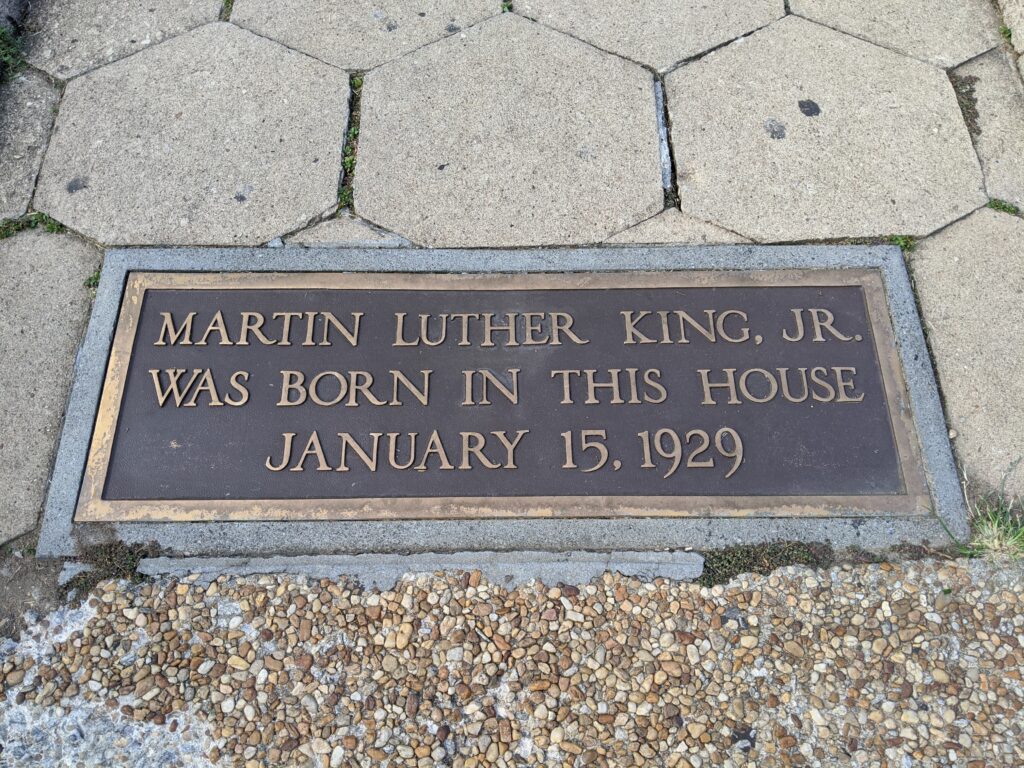
Today is the U.S. federal holiday in observance of Reverend Doctor Martin Luther King, Jr’s birthday. King was born January 15, 1929. He was a civil rights activist and a Baptist minister, and he was a leader of the civil rights movement until his assassination on April 4, 1968. He advanced civil rights for people of color in the United States through the use of nonviolent resistance and civil disobedience against Jim Crow laws and other forms of legalized discrimination, which primarily affected African Americans.
Atlanta has been a key player in the struggle for civil rights in the U.S. Following the civil war and emancipation, newly freed, former slaves flocked to Atlanta to establish themselves as free workers and business owners. Downtown Atlanta and adjacent Auburn Avenue became centers of entrepreneurial success, and Auburn Avenue became the richest black business district in the United States.
Of course, there was a lot of resistance from white people, particularly less educated and poorer white men, who viewed the success of black Americans as a barrier to their own success. This led to a series of laws designed to limit the rights of black Americans and keep them in virtual servitude, even though they were legally free.
There’s a lot of history tied up in Atlanta that is related to race. Segregation, education or lack thereof, the 1906 race riots, the manner of urban development and politics which kept black and white citizens in separate neighborhoods. I’ll make a post about that sometime, because it’s really quite fascinating.
But for today, I want to remember Martin Luther King, Jr. He was the voice of decency and an advocate for change in a divided nation. We know him for his “I have a dream” speech. We know him because he died young in 1968. But it’s so interesting to me that he is still revered in this country. He wasn’t a president. He wasn’t even a politician. But his principles of nonviolence and civic action continue to influence people today, particularly in the demonstrations during this current administration. I just learned that he was awarded the Nobel Peace Prize in 1964, and he accepted it “with an abiding faith in America and an audacious faith in the future of mankind” and saying that “what self-centered men have torn down men other-centered can build up.” This resonates particularly strongly today.
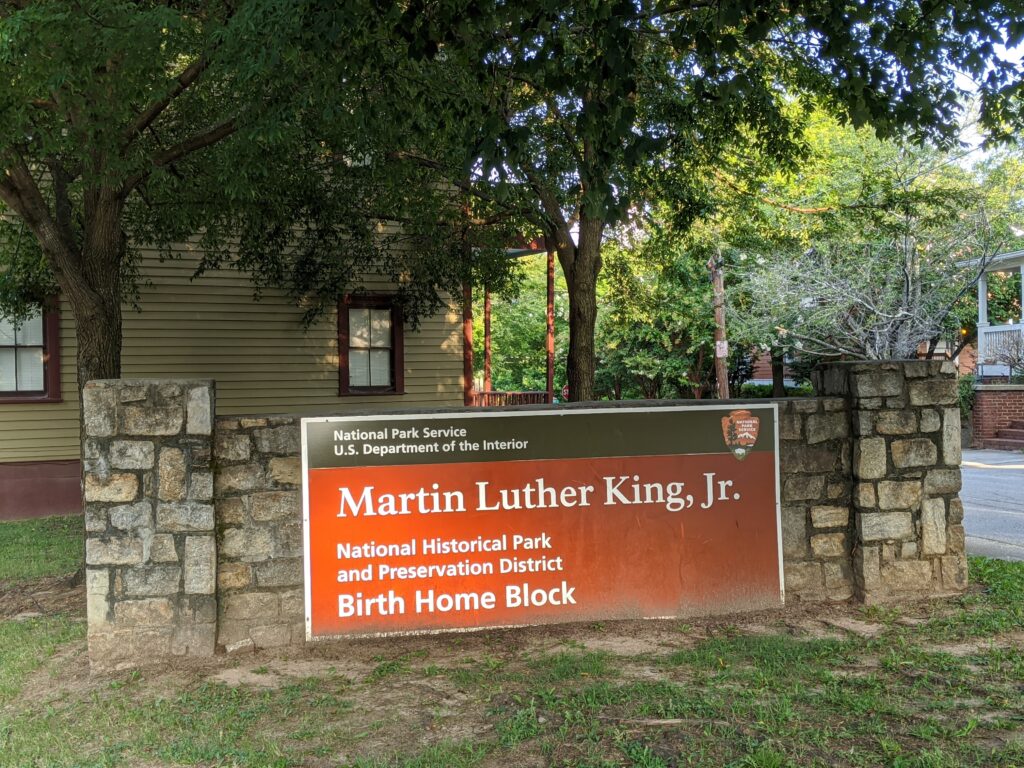
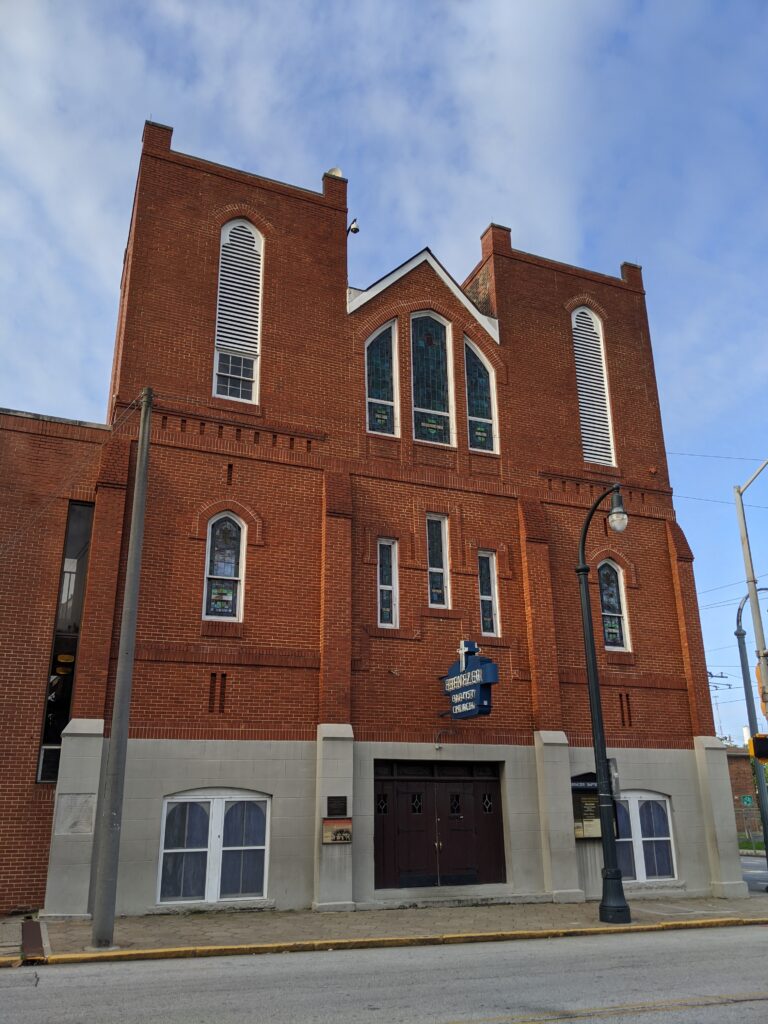
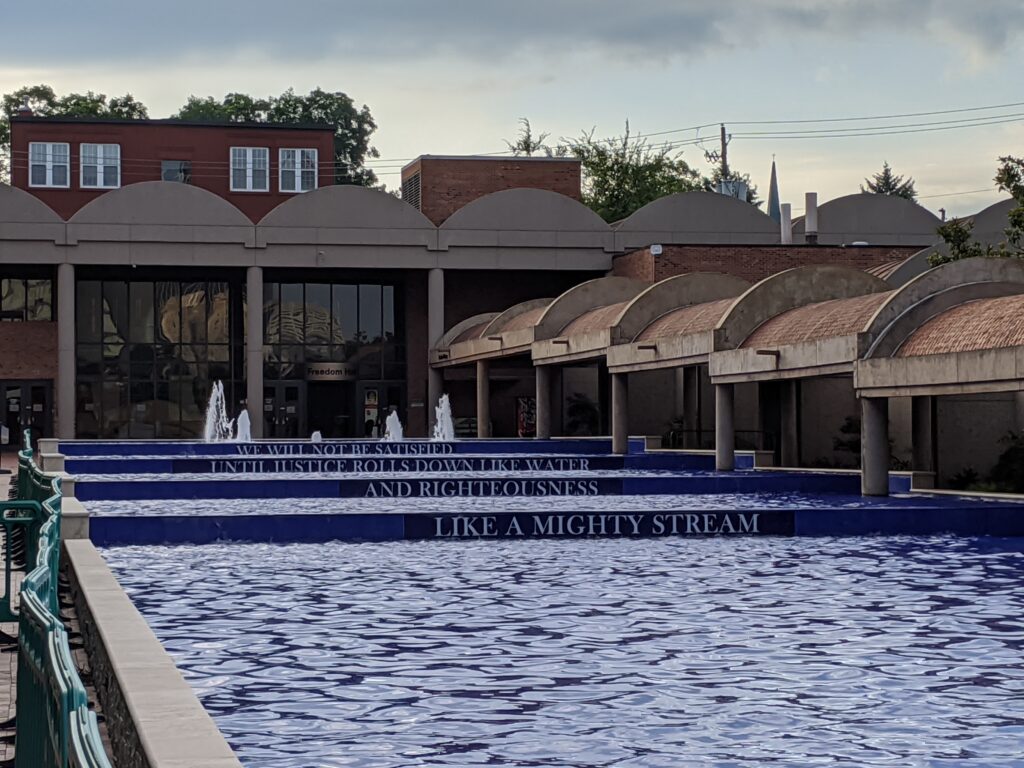
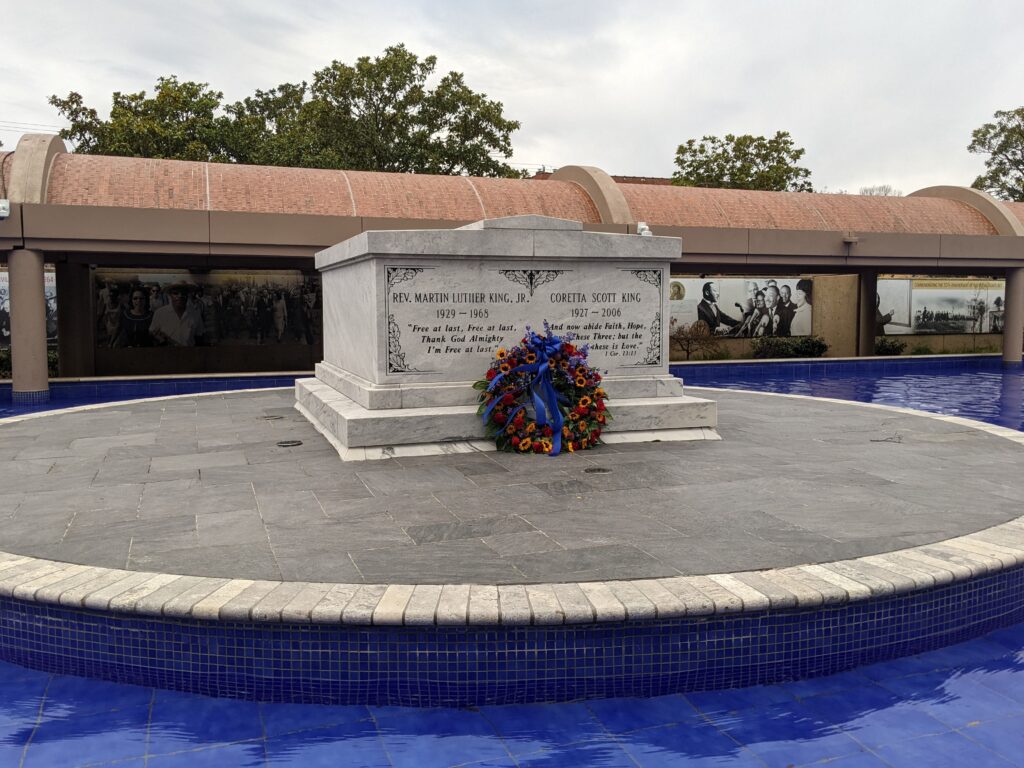
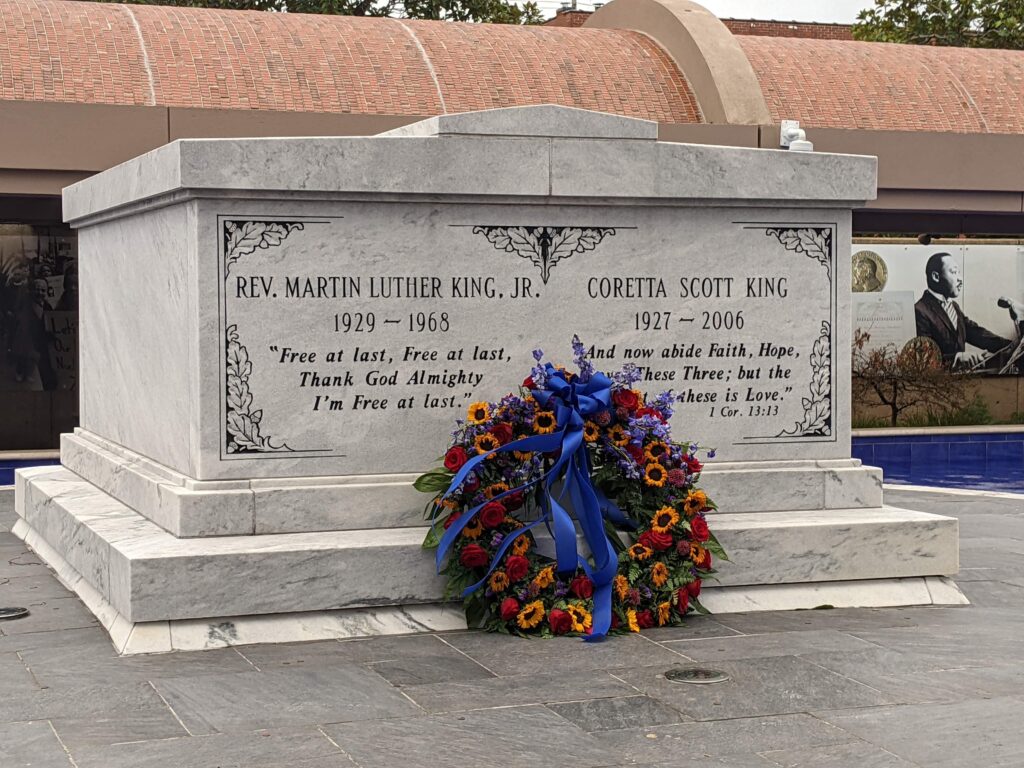
The Martin Luther King, Jr. National Historical Park and Preservation District is just a 10-minute walk from my house, and I walk through this neighborhood on my way home from work which feels like a monumental privilege as an American. It is the only national park located in an urban area, and it is right in the middle of Atlanta. The district includes the house where he was born, Ebenezer Baptist Church where he and his daddy and his granddad preached, and the Center for Nonviolent Social Change Inc which was created by Coretta Scott King after her husband’s death.
I’ll make another post in the future with more details about this district. But for today, here are some photos in honor of Martin Luther King Jr’s birthday and legacy as an American figure.
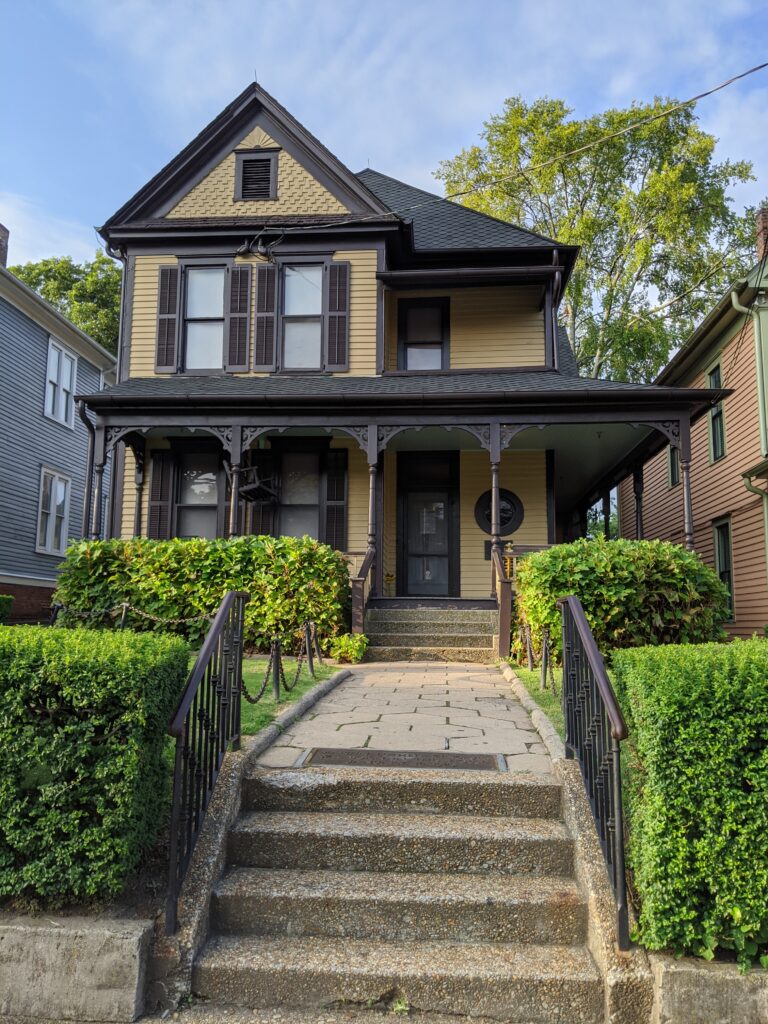
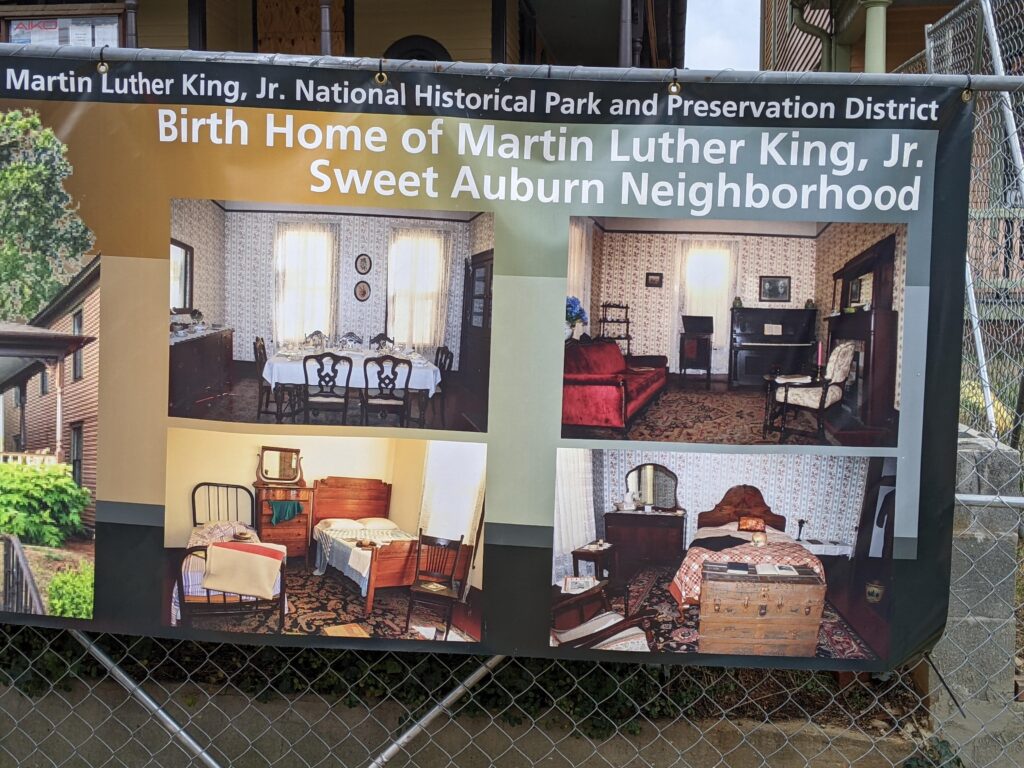
Just a 10-minute walk from my house, the weight of living near here is not lost on meMartin Luther King Jr’s house from birth to age 12The house is going through restoration, but there are photos of the interior posted on the construction fencehistoric Ebenezer Baptist ChurchA view of the Center for Nonviolent Social Change Inc and its reflecting poolThe tombs of Martin Luther King, Jr and Coretta Scott King are in the middle of the reflecting poolThe tombs have a special celebratory wreath for the weekend of MLK holiday
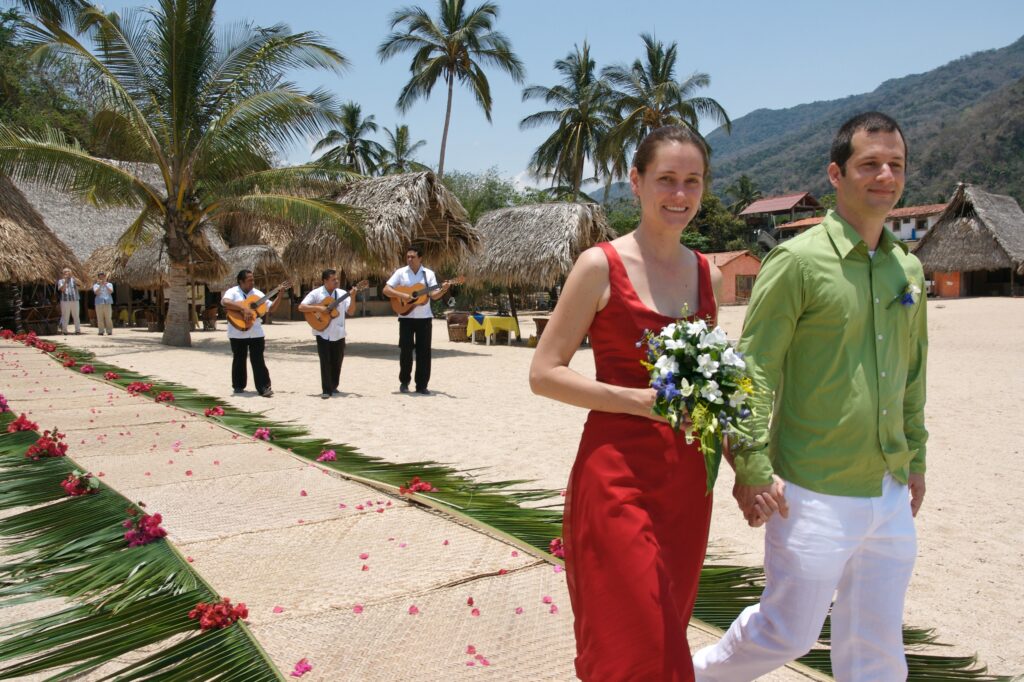
Chad and I got married in June 2007. Over the next few months, we started saving money for a down payment for a house, and we started to look at real estate. We were living in Emeryville, across the bay from San Francisco, and we quickly realized that most real estate was out of range for us. At the time, we were looking at paying $500,000 for a one-bedroom apartment in San Francisco, or we could pay the same amount for a fixer-upper in a run-down neighborhood in Oakland.
We quickly decided that it was time to move out of the Bay Area, and we tentatively decided on Atlanta. Chad had lived in Atlanta for 9 years before moving to San Francisco in 2004, but I had never been there.
In July 2008, a year after our wedding, my Abbott family reunion was held in North Georgia and Tennessee. Chad and I took advantage of that reunion to fly to Georgia early and spend a week in Atlanta so I could get to see the city. Honestly, I had moved around enough since the age of 17 that I knew I could settle in and feel at home anywhere, but it was nice to get a preview of Atlanta before making the commitment to move. And so the decision was made.
One day that fall, Chad and I were walking to the BART train to go to work, and he said, “I’ve been thinking. Since we’re going to quit our jobs, pack up our things and move across the country, what if we take part of our down payment money and travel in Europe for a while? Is that a crazy idea?” I paused for about a nanosecond and said, “That’s an excellent idea!”
We left the Bay area in mid-March 2009, and we spent the next seven months traveling throughout Portugal, Spain, France and Italy. During that sabbatical, I kept a travel blog where I chronicled our journey, and my love of blogging was born. It was a great way to bring family and friends along on our adventures, and it became a journal and photo album that I have re-read over the years.
Since then, I have continued the travel blog for other international trips to France and Italy and, most recently, Antarctica and Buenos Aires. We’ve taken trips to other places during the last several years, but I’ve learned that it’s difficult to keep up with a blog if a trip is only one, two or three weeks, because there’s not a lot of “down” time. Some of those other trips that we’ve taken together but not posted on the blog include Jamaica, Panama (twice), Italy in 2018, and Madrid. I’ve also traveled for work without Chad to Bangalore India, Johannesburg South Africa, Sardinia Italy, and Grand Cayman, and he’s traveled to Bogota Colombia a few times without me. In hindsight, I wish I had documented all of those trips on the blog, but those experiences are on Facebook instead. Maybe some day I’ll pull together the info for those adventures and put it all on the blog.
After our sabbatical in Europe, we arrived in Atlanta in October 2009, so we’ve now been here 16 years. I’ve realized that I haven’t chronicled any domestic experiences on the blog, so 2026 will be focused on My Atlanta. I’m going to treat it as if we are visitors in our own city and make blog posts with fresh eyes.
Some day, we will retire and move to Italy, and I want to create a journal and photo album so I can look back on our life here. I’ve also realized that, when I write a blog post, I slow down and really think about what I’m seeing and experiencing, and I take the time to process the experience in a different way. I want to do this for Atlanta.
I want to chronicle my experiences throughout the year, from the simple things like my commute to work which passes through historic neighborhoods to special events like local festivals and the World Cup. I want to document the places that are meaningful to me such as our beautiful Inman Park neighborhood, the Atlanta Beltline, and the Atlanta Botanical Gardens. I’m sure we’ll have many amazing meals, and there will be photos of food, of course.
Ultimately, I am blessed in life and am extremely happy in Atlanta. It’s been a great home for 16 years, and I want to get it all on paper, so to speak. I’m very much looking forward to this project throughout the year. Stay tuned for more blog posts, and I hope you enjoy the ride.
June 12, 2007 – the beginning of a great adventure