Uncategorized

Arrival in Guardialfiera

We arrived in Guardialfiera two days ago, and this will be our home for the next two months.  Guardialfiera is a hilltop village in central Italy with a population of about 1,000 people.  A main street runs through the middle of the village with a couple of parallel streets on either side, some of which are pedestrian-only.  These streets are all interconnected with cross-streets and pedestrian ways.  The main street is so narrow that it is one-way and only has parking on one side.

View from our apartment up the main street towards the main plaza

View from our apartment up the main street towards the main plaza

view from our apartment down the main street towards the churches

view from our apartment down the main street towards the churches

To support the population, the village has a small grocery shop; a butcher shop with meat, poultry, and cheese; a flower shop; a “multi-purpose” shop with everything from groceries to toys to jewelry; a pharmacy; a bakery; a flower shop; a clothing store; and four bars/cafes.  In addition, there is a larger church at the top of the hill and a smaller church on the main street.  And of course, there is the town hall.  We’ve also seen the offices of a civil engineer, a lawyer, and an architectural products studio (selling windows, shutters, etc).  There are two restaurants a couple of kilometers outside of the village, and we plan to check those out, perhaps this weekend.  I’ll post some photos of the village in the next day or so.

We can find almost everything we need in the village, but we decided to make a grocery run to the nearest larger town to get some additional essentials.  This other town was also up in the mountains, and on this rainy day, it was literally in the clouds.  It took 40 minutes to get there, so I’m thankful that we can find most things in our village such as vegetables, fruit, bread, eggs, milk, cheese, meat, poultry, butter, wine, yogurt. 

we bought this broccoli in our little village for 50 cents, best broccoli of my life, presumably fresh from the farm - wine bottle for scale - Chad noted "this would have cost 6 dollars at our local farmers market in Atlanta"

we bought this broccoli in our little village for 50 cents, best broccoli of my life, presumably fresh from the farm – wine bottle for scale – Chad noted “this would have cost 6 dollars at our local farmers market in Atlanta”

Essentials from the nearby town - chili pepper crackers, fennel/anise tea, creme caramel, cheese, mortadella, local pasta, our favorite chips in red pepper and lime flavor, fig jam, unfiltered beer from Sardinia, cookies, genziana (a local after-dinner liqueur), Campari, and yes, two jugs of table wine

Essentials from the nearby town – chili pepper crackers, fennel/anise tea, creme caramel, cheese, mortadella, local pasta, our favorite chips in red pepper and lime flavor, fig jam, unfiltered beer from Sardinia, cookies, genziana (a local after-dinner liqueur), Campari, and yes, two jugs of table wine

view of the grocery store parking lot up in the clouds - it looks like fog, but we were actually in the clouds

view of the grocery store parking lot up in the clouds – it looks like fog, but we were actually in the clouds

Down in the valley is Largo di Guardialfiera (the lake).  This used to be just a river, but a dam was built in the 1970s to create the lake to provide a water supply for the surrounding towns and farmland.  We have a great view of the lake from our apartment.

view of the valley and the lake with some Guardialfiera houses in the foreground

view of the valley and the lake with some Guardialfiera houses in the foreground

The people here are very nice.  The village is small enough that people walk everywhere, and everyone says hello.  Several people have stopped to chat with us since we are a bit of a curiosity as outsiders.  Our car has French license plates, so people keep asking us if we are French.  Now that we’ve been here a couple of days, I think word has gotten around town that we are American. 

here's our little car parked in front of our apartment - just before lunch today, it was surrounded by little boys checking it out since it's an out-of-town car

here’s our little car parked in front of our apartment – just before lunch today, it was surrounded by little boys checking it out since it’s an out-of-town car

We leased our car from a company in Paris, so it has French license plates

We leased our car from a company in Paris, so it has French license plates

We are making a point of getting out and about so we can meet people and become integrated into the village.  We’re also trying to go to all of the little stores and bars so we can meet the shopkeepers, strike up conversations, and support local business.  Sure, it’s more convenient to make a coffee or tea at home, but it’s so much fun to the go the bar and get a proper cappuccino and a pastry for breakfast.  And then at the end of the day, you go back to the bar to get a beer or a small aperitivo/cocktail and chat with your friends before dinner.

Our apartment is on the main street right in the center of the village. We’re up on the second floor, so we get great daylight.  (The apartment below us is vacant.)  The bedroom balcony looks out over the  valley, the lake, and the hills beyond, and the living room balcony looks out on the main street. 

the door to our upstairs apartment is the lighter wood door on the right - our living room balcony looks out over the street

the door to our upstairs apartment is the lighter wood door on the right – our living room balcony looks out over the street

our downstairs entryway - note the various bins for recyclables

our downstairs entryway – note the various bins for recyclables

the stairs up to our apartment with a coat rack at the top - that curtain hides a little storage area with broom/mop/ironing board/etc

the stairs up to our apartment with a coat rack at the top – that curtain hides a little storage area with broom/mop/ironing board/etc

The apartment has a large room that is the kitchen/living room.

entrance to the kitchen/living room

entrance to the kitchen/living room

the seating area - the built-in cabinets house dishes and pots and pans

the seating area – the built-in cabinets house dishes and pots and pans

dining table and TV and 5-liter jug of red wine sitting on a chair

dining table and TV and 5-liter jug of red wine sitting on a chair

kitchen wall - notice the green apron hanging on the wall that Chad brought from home

kitchen wall – notice the green apron hanging on the wall that Chad brought from home

the fridge and freezer are cleverly hidden in the cabinets

the fridge and freezer are cleverly hidden in the cabinets

the cabinet over the sink has a dish rack - we've seen this in several apartments in Italy - and the sink has a built-in dish drain area - genius!

the cabinet over the sink has a dish rack – we’ve seen this in several apartments in Italy – and the sink has a built-in dish drain area – genius!

Here’s the bedroom.

view into the bedroom

view into the bedroom

view towards the bedroom balcony

view towards the bedroom balcony

Here’s the bathroom.  Thankfully, the bathroom has a washing machine so we can do laundry here.  (Italians don’t use dryers, so we have a clothesline on the balcony off of the bedroom.)

view into the bathroom

view into the bathroom

bathroom with a washing machine in the corner

bathroom with a washing machine in the corner

I couldn’t be happier with this place.  Chad is working remotely for the first few weeks, so his new “home office” is the dining table.  My home office is a comfy chair in the bedroom with a great view of the valley.  “You’re not working,” you say.  “Why do you need a home office?” you ask.  Who cares!  I can sit here all day, reading a book, crafting a travel blog post, studying Italian, or just staring at the scenery.

my home office with a view

my home office with a view

We will make an occasional run to the big grocery store in the nearby town, and we will take some day trips to see various parts of the Molise region.  However, we plan to spend most of our time in this little village, meeting people, practicing our Italian, eating and drinking delicious things, and living the slow life.  Here are some views throughout the day looking east towards the valley.

6:00 am

6:00 am

7:30 am

7:30 am

8:30 am

8:30 am

10:30 am

10:30 am

5:00 pm

5:00 pm

6:30 pm

6:30 pm

8:00 pm

8:00 pm

As we were taking our evening walk today, we stopped to look at a bulletin board that showcases local real estate listings.  Hmmm… 

Standard
Uncategorized

Campobasso Photo Dump

So, we’ve left Campobasso, and I have some photos that I haven’t shared, yet.  Here’s a dump of misc photos of things that caught my eye, in no particular order:

Now in the heart of the city center, Piazza Pepe is just outside of the old city walls - it was originally a wooded area where shepherds would rest with their sheep while traveling from one pasture area to another - the trees were cleared in the 1500s to create this public plaza

Now in the heart of the city center, Piazza Pepe is just outside of the old city walls – it was originally a wooded area where shepherds would rest with their sheep while traveling from one pasture area to another – the trees were cleared in the 1500s to create this public plaza

We found this map of the old city center mounted on the wall of a house - the castle and its nearby churches are the brown buildings in the center of the map

We found this map of the old city center mounted on the wall of a house – the castle and its nearby churches are the brown buildings in the upper left quadrant of the map

close-up of the bark of the pine trees on the path up to the castle - the bark is thick and very three-dimensional

a close-up of the bark of the pine trees on the path up to the castle – the bark is thick and very three-dimensional

This species of flower is critically endangered and is only found on the mountain near the castle, it is found nowhere else in the world

This species of flower is critically endangered and is only found on the mountain near the castle, it is found nowhere else in the world

This Smart car is covered in a houndstooth pattern

This Smart car is covered in a houndstooth pattern

This church looks like it was built in the '60s, I like the open-air bell tower

This church looks like it was built in the ’60s, I like the open-air bell tower

I like this newish door installed in an old portal

I like this newish door installed in an old portal

In the U.S., you can see architecture designs with exposed air ducts, but this is the first time I've seen a fan attached to the duct

In the U.S., you can see architecture designs with exposed air ducts, but this is the first time I’ve seen a fan attached to the duct

Speaking of interesting architecture, check out the emergency exit stairs on this building

Speaking of interesting architecture, check out the emergency exit stairs on this building

Here's a statue of a local singer-songwriter, composer, and producer - someone put a scarf on him because it was cold outside

Here’s a statue of a local singer-songwriter, composer, and producer – someone put a knit scarf on him because it was cold outside

Here is a package of Stranger Things chocolate candies - there were also versions with Star Wars Mandalorian, Marvel, Frozen, and others

Here is a package of Stranger Things chocolate candies – there were also versions with Star Wars Mandalorian, Marvel, Frozen, and others

And finally, we had a bottle of Falanghina white wine at lunch - we discovered Falanghina while in Ischia and have been pleasantly surprised to learn that the Molise region also makes this type of wine

And finally, we had a bottle of Falanghina white wine at lunch – we discovered Falanghina while on the island of Ischia and have been pleasantly surprised to learn that the Molise region also makes this type of wine


Standard
Uncategorized

Liberty Style and Art Deco Architecture in Campobasso

Campobasso has some really interesting buildings.  Following WWI, there was a surge of construction around the old city center during the 1920s.  You can see examples of the Liberty Style (the Italian version of Art Nouveau) as well as examples of Art Deco.  We had a booklet in our apartment that talked about several of these buildings, so of course I took Chad on walking tours to find them.

The Teatro Savoia is on a small central plaza.  The overall building looks classical, but the ironwork on the entry door and balconies is definitely the art-nouveau-inspired Liberty style.  This building is still in use today as a performance theater.  You can search online to find images of the interior.

Teatro Savoia facade

Teatro Savoia facade

Teatro Savoia main entry

Teatro Savoia main entry

Several of the buildings we saw were mansions built by wealthy families.  Across the street from the Teatro Savoia is a house that mixes classical plaster detailing above the windows with Liberty style balcony railings inspired by organic, natural forms.

Note the Liberty-style balcony railings - there is a pharmacy on the ground floor which was closed for lunch when I took the photo, which is why the shutters are closed

Note the Liberty-style balcony railings – there is a pharmacy on the ground floor which was closed for lunch when I took the photo, which is why the shutters are closed

The Villa Maria takes up an entire city block.  While this house also takes cues from classical architecture, the detailing is Liberty and Art Deco.

Villa Maria facade

Villa Maria facade

Decorative detail

Decorative detail

At this house, the shorter, three-story part was built in the 1920s.  The taller four-story portion was built in the 1960s, and it wraps around the original house in the form of an L.  You can see a little bit of the 60s-era windows of the sunroom and the porches below it on the back side.  I like that the addition is in harmony with the original, but it also is of the 1960s design era.

1920s mansion with 1960s addition

1920s mansion with 1960s addition

This house was built for the family of an engineer.  What’s interesting here is that the brickwork is left exposed, and the decorative elements are made of concrete and aren’t covered in plaster/stucco.  Maybe this was a nod to the owner’s engineering profession, leaving the structural elements exposed to view.
The engineer's house

The engineer’s house

Detail of the concrete decorative elements

Detail of the concrete decorative elements

The State Music Conservatory was built during an earlier period, but it looks like window grilles and fences were added in the style of 1920s.
The entrance to the conservatory

The entrance to the conservatory

Some of the houses used an original building from an earlier era on the bottom floor(s) and put an addition on top.  Here’s one of them.  Note the Art Deco decorations, more geometric than Art Nouveau.

Another 1920s mansion

Another 1920s mansion

And... a closeup of decoration

And… a closeup of decoration

And then there’s this interesting house in the old city center where the lower two floors were built during a much earlier era and the upper floors were added in the 1920s.  You can clearly see the stylistic difference in the facade design and materialistic treatment.  Even just comparing the balcony railings at the second and third floors, you can see the difference.  The most interesting thing to me is the use of wrought iron “supports” at the eave of the roof.  In other buildings, these supports are made of stone (reference photos of previous houses).  Note that these iron supports are merely decorative, as wrought iron could never support a roof overhang like that.  Instead, there are interior roof beams and rafters which are supporting that roof eave as it extends over the exterior wall.

The facade

The facade

Detail of the upper floors

Detail of the upper floors

And finally, to speak more about wrought iron…  Campobasso is known throughout Europe for its ironwork, and four generations of the Tucci family created architectural elements over several decades.  The heyday was in the early 20th century when the foundry designed and built balcony railings (including many of the items seen in previous photos), fences, gates, lamp posts, park benches, and other decorative elements.  Here are some ironworks that we saw on our walks.

Entry to the Villa Capoa gardens, note the cool street lamp

Entry to the Villa Capoa gardens, note the beautifully designed street lamp

The main entry gate to the Villa Capoa

The main entry gate to the Villa Capoa gardens

The main light pole in the Capoa park

The main light pole in the Capoa park

A park bench in the little park/plaza next to Piazza Pepe

A park bench in the little park/plaza next to Piazza Pepe

And finally, a detail of the balcony railing at the Teatro Savoia - I saw this and said to Chad, "This reminds me of Antoni Gaudi"

And finally, a detail of the balcony railing at the Teatro Savoia – I saw this and said to Chad, “This reminds me of Antoni Gaudi”

Standard
Uncategorized

Campobasso Castle and Churches

The old town city center of Campobasso has lots of interesting nooks and crannies to explore.  Narrow cobblestone streets curve out of sight, inviting you to walk just a little bit further to see what’s around the curve.  The old town is located around the base of a mountain, so sometimes the “street” goes up an incline via steps instead of what you would think as a drivable street.

Catty-corner from the osteria where we had dinner the first night, there is a small plaza called Largo di Leonardo which is named after the Chiesa di San Leonardo which fronts the plaza.  When traveling in Europe, we have a rule that we always have to pop into a church when we pass by, and this church did not disappoint.

La Chiesa di San Leonardo

La Chiesa di San Leonardo

The nave of San Leonardo

The nave of San Leonardo

A view of the side aisle and windows above

A view of the side aisle and windows above

The rose window depicts a ship, perhaps to acknowledge that the city of Campobasso is just a few kilometers from the sea

The rose window depicts a ship, perhaps to acknowledge that the city of Campobasso is just a few kilometers from the sea

Next to the church was a grand set of stairs, and we said to ourselves, “Huh, I wonder where those steps go.”  So we started going up.  And up.  And up.  We eventually found ourselves at the top of the mountain, passing narrow houses all along the way.

Hmm...where do these steps go?

Hmm…where do these steps go?

And on the way up the mountain, we saw this side street going back downhill

And on the way up the mountain, we saw this side street going back downhill

There are some interesting structures at the top of the mountain.  The first thing you see when you crest the hill is an old defense tower. 

Note the little tiny slots in the tower which would allow soldiers to shoot arrows while being protected

Note the little tiny slots in the tower which would allow soldiers to shoot arrows while being protected

Next to the tower is La Chiesa di San Bartolomeo, built in the 13th century in the Romanesque style.  The Romanesque period predates the Renaissance and the Gothic style, and the architecture is much simpler.

Facade of San Bartolomeo

Facade of San Bartolomeo

Central nave of San Bartolomeo - note the wooden roof

Central nave of San Bartolomeo – note the wooden roof

There is a rose window, but it is just clear glass

There is a rose window, but it is just clear glass

Going up a few more steps on the path, you come to La Chiesa di San Giorgio, a Romanesque church which was also built in the 13th century.  (I haven’t figured out why two churches were built at the same time right next to each other.)  The interior of this church was renovated a couple of decades ago, and you can see how it looks much different than the San Bartolomeo church.  It has new plaster on the walls and ceilings as well as added decorative elements.

The facade of San Giorgio

The facade of San Giorgio

The central nave

The central nave


The rose window is clear glass

The rose window is clear glass

Saint George slayed a dragon, and this is the homage to the saint within the church  (Note: Antoni Gaudi designed a house in Barcelona which was inspired by St George...google the images to see the sword - chimney - slaying the dragon - the roof with 'dragon-scale' roof tiles)

Saint George slayed a dragon, and this is the homage to the saint within the church (Note: Antoni Gaudi designed a house in Barcelona which was inspired by St George…google the images to see the sword – chimney – slaying the dragon – the roof with ‘dragon-scale’ roof tiles)

During the recent renovation, portions of the original fresco paintings in the Campobasso church were left exposed

During the recent renovation, portions of the original fresco paintings in the Campobasso church were left exposed

Leaving the San Giorgio church, you go up a tree-line lane to the very top of the mountain.  The pine trees along the lane are each dedicated to a different soldier (presumably a local man) who died in WWI.  Each tree also has a tag with a QR code that is used by some entity (regional or federal government?) to track data about that particular tree.

The tree-lined path up to the castle

The tree-lined path up to the castle

This tree is dedicated to Soldato (soldier) Giovani de Santis who died in 1917

This tree is dedicated to Soldato (soldier) Giovani de Santis who died in 1917

A tag to identify this particular pine tree

A tag to identify this particular pine tree

At the top, you first see an old monastery.  Then you curve around and see the modern addition to the building which is still a working monastery.

The original monastery building

The original monastery building

The original monastery with its addition

The original monastery with its addition

Finally, across a small plaza is the castle.  The castle isn’t open to the public because – ta-da! – it is now used as a weather station administered by the national army. 

Notice the weather instruments on the old castle

Notice the weather instruments on the old castle

There was a free-flowing water fountain at the top of the mountain in front of the monastery

There was a free-flowing water fountain at the top of the mountain in front of the monastery

Our guidebooks poo-poo’d the notion of hiking up the mountain to the castle, saying that it is better viewed from afar.  Whatever!  The hike was fun, not knowing exactly where all of those steps would lead, and the views from the top of the mountain were wonderful. 

View from the mountaintop

View from the mountaintop

A close-up of the snow-capped mountains across the valley

A close-up of the snow-capped mountains across the valley

Plus, on the way down, we popped into a restaurant for lunch and had a delicious meal that we would have missed if we hadn’t decided to hike up the hill.

See previous post for more about this restaurant

See previous post for more about this restaurant

Standard
Uncategorized

The Museo Sannitico of Campobasso

The City of Campobasso has the oldest museum in the region of Molise.  This might sound like a “big-whoop” bragging right, but get this – this archeological museum contains items from the third millennium BC.  That is 5 thousand years ago!  In my mind, that is definitely “big-whoop.”  This makes Rome, with its more-recent empire only 2 thousand years ago, a little bit of a “newbie” experience.

Arrow heads, daggers, blades, and axe heads from 3rd millennium BC through 7th century BC

Arrow heads, daggers, blades, and axe heads from 3rd millennium BC through 7th century BC

Before the Romans conquered the central Italian peninsula, the Samnites inhabited the land.  There were two main tribes – the coastal tribe on the east coast of the peninsula and the mountain tribe living in the mountains that go down the center of the Italian peninsula.  By all accounts, the Samnites were peaceful people who enjoyed trading with other groups – the Etruscans to the northwest, the Greeks to the southeast, and the peoples in what we now consider the Middle East.

The museum has exhibits that show influences from these different neighboring areas.

The design of these Samnite vases was influenced by the Greeks

The design of these Samnite vases was influenced by the Greeks

A replica of a ship's bow shows how goods were transported and traded with other cultures - these jars would hold wine, oil, sauces, fish sauce, and fruit

A replica of a ship’s bow shows how goods were transported and traded with other cultures – these jars would hold wine, oil, sauces, fish sauce, and fruit

Being an archeological museum, the key focus is on artifacts that have been discovered in ancient ruins and burial grounds in the area.  You can see ancient eating dishes, oil lamps, wine jars, building motifs, and religious artifacts. 

Plates and jars

Plates and jars

Oil lamps

Oil lamps

Figurines of Hercules

Figurines of Hercules

One of the key facts that the exhibits keep coming back to is that most of these artifacts have been recovered/discovered from ancient burial graves.  Men were buried with communal ceremonial dishes/cups because they would share a meal to celebrate a communal victory. 

Women would be buried with cooking pots, wine vessels and jewelry and elaborate clothing, because they were the keepers of the home.  Being buried with these things was an honor. 

The items on the red display platform and to the left were discovered in female graves, the items to the right are from male graves

The items on the red display platform and to the left were discovered in female graves, the items to the right are from male graves

Necklaces and bracelets made from metal, beads made from stone, amber, and pottery

Necklaces and bracelets made from metal, beads made from stone, amber, and pottery

Children were buried with cups that didn’t have handles (presumably because children couldn’t deal with handles and had to hold cups with both hands) and little girls who died would be buried with jewelry (to signify a wedding that wouldn’t happen) and other trinkets to signal a loss of future contribution to the community.  Same for the boys, but I don’t remember those trinkets because I’m not a boy.

Toys and trinkets

Toys and trinkets

The most arresting exhibit in the museum is that of the excavation of a warrior and his horse.  While it’s apparently common to find a human buried with worldly goods, this grave included worldly goods for the horse, like his stirrups, reins, blanket, etc.  The signage said that being buried with a horse signified that this person was kind like a chief.  Other soldiers who were also good soldiers were buried without their horses.

Warrior and his horse buried together

Warrior and his horse buried together

While my interest in going to this museum was to learn more about the Samnites living in the area (in which there are still a lot of remnants in the countryside), it was also interesting to see other things which had been excavated over many centuries. 

There are tools from the 3rd millennium BC and pottery from the 15th century AD and everything in between.

15th century AD majolica pottery

15th century AD majolica pottery

I think my favorite moment in the museum was when Chad and I were looking at an exhibit of old coins from 300 BC and he said, “Well, it seems money hasn’t changed in a long time.”

Coins from 3rd-1st centuries BC

Coins from 3rd-1st centuries BC

I would definitely recommend a visit to this museum.

Exhibit of warrior findings - tools, weapons, and horse gear

Exhibit of warrior findings – tools, weapons, and horse gear

Standard
Uncategorized

Restaurant Tour of Campobasso

Tomorrow we head to Guardialfiera, our home for the next two months.  From what I can see on Google maps, there is only one restaurant in the town.  Therefore, we decided to splurge on eating out during our 4 days in Campobasso, even though we have an apartment with a good kitchen.  We plan to prepare our own meals in our apartment in Guardialfiera.

In Italy, it’s common to go out for an aperitivo (a small drink) and a snack around 6 pm.  This tides you over until dinnertime at 8 pm or later.  Chad and I embrace this custom when we are in Italy.  You have a small beer or wine or cocktail and savory snacks while you socialize and people-watch.  Happy hour usually lasts 1-2 hours.  Here’s our happy hour one evening:

Bar Luppachioli – assorted cured meat, toast, and toast with chopped tomatoes, a Negroni cocktail and a gintonic

For meals, here’s what we ate during our long weekend in Campobasso.  (File this blog post under “Food Porn.”)

Osteria Cannavina:

This was where we dinner down in the cave-like basement.  This dinner took 2-1/2 hours.

The dining area is down in the basement among the old building structure

The dining area is down in the basement among the old building structure

– Appetizer – mix of salumi (cured meats), squash flan with pecorino sauce.

mixed salumi

mixed salumi

squash flan was so delicious that I almost started crying

squash flan was so delicious that I almost started crying

– Pasta course – tagliatelle au ragu di coniglio (pasta with rabbit sauce), tortellacci dell’Osteria (house tortellini stuffed with pork).

bunny rabbit tastes good!

bunny rabbit tastes good!

tortellacci - giant tortellini

tortellacci – giant tortellini

– After-dinner drink – genziana (local liqueur made from local ginseng root).  We first had this at Chad’s relative’s house just north in Abruzzo.  It is earthy and savory and “forte” (strong).  You just have a small glass of this after a meal, and it helps with the digestion.  (See below for photos.)

Il Sagittario:

There was no menu.  The server listed off the items for each course, and then you told him what you wanted.  Keep in mind that we went to a bar for a cocktail and snacks before going to the restaurant, so I was not as hungry as I thought.  The server convinced us to each get our own appetizer plate, and then he was scandalized when I said I was full afterwards and that I couldn’t eat even a pasta course.  I did eat a little bit of Chad’s pork dish, because he was also kind of full.  This dinner took 2-1/2 hours.

  • Appetizer – mixed items.  See photo below for a list of all the items.
clockwise from bottom left - cured ham, the "wrap" is veggies and mozzarella, a little sandwich with spicy soppressata and the "bread" was the light pastry bread that you find in an eclaire, an omelette slice rolled with veggies, mashed potatoes with a cheesy crust, roasted eggplant, english scone/biscuit with jam, buffalo mozzarella

clockwise from bottom left – cured ham, the “wrap” is veggies and mozzarella, a little sandwich with spicy soppressata and the “bread” was the light pastry bread that you find in an eclaire, an omelette slice rolled with veggies, mashed potatoes with a cheesy crust, roasted eggplant, english scone/biscuit with jam, buffalo mozzarella

homemade chips with cheese and truffles, melted cheese with honey and walnuts

homemade chips with cheese and truffles, melted cheese with honey and walnuts

  • Meat course – pork roasted in red wine with bitter greens and homemade chips.
  • Dessert – biscotti.
  • After-dinner drink – genziana.
our genziana came in a little bottle to split for two glasses

our genziana came in a little bottle to split for two glasses

Ristorante Miseria & Nobilta:

This family-run restaurant has been around for years, and all the pasta is made in-house.  All dishes and ingredients are local, and there is the option to make most of the dishes vegetarian, vegan, and/or gluten-free.  In Italy!  This lunch took 2-1/2 hours.

the antipasto (appetizer) menu: red means "can be made vegetarian," green means "can be made vegan," tan means "can be made gluten-free," blue means either "raw fish" or raw meat".  this variety was typical throughout the menu.

the antipasto (appetizer) menu: red means “can be made vegetarian,” green means “can be made vegan,” tan means “can be made gluten-free,” blue means either “raw fish” or raw meat”. this variety was typical throughout the menu.

  • Amuse-bouche – sliced polenta with bitter greens and pecorino.
  • amuse-bouche

    amuse-bouche

  • Appetizer – smoked salmon and orata tartare with green apples and fennel.
antipasto

antipasto

  • Pasta course – tricolor gnocchi (to represent the colors of the Italian flag) with broccoli rabe, cavatelli with broccoli, pecorino and guanciale (pig cheek).
gnocchi

gnocchi

cavatelli

cavatelli

  • Dessert – panna cotta with espresso and amaretto cookie sprinkles, creme brulee with licorice flavor.
panna cotta

panna cotta

creme brulee

creme brulee

  • After-dinner drink – genziana, espresso.
genziana

genziana

Kudeta:

We stopped in here on our first night for a happy hour cocktail, and the experience and snacks were so good that we made reservations to go back another night for dinner.  The menu had several items with an Asian influence.  This dinner took 2-1/2 hours.

happy hour cocktail and snacks

happy hour cocktail and snacks

one of the dining areas

one of the dining areas

  • Amuse-bouche – fried polenta with roasted bell pepper cream.
fried polenta

fried polenta

  • Appetizer – shrimp with an Asian dipping sauce, cannoli filled with bacala (salt cod) and sauce of roasted peppers.
the shrimpies

the shrimpies

savory cannoli

savory cannoli

  • Pasta course – ravioli cinesi (pork-stuffed ravioli served with gyoza sauce).
  • ravioli cinesi

    ravioli cinesi

  • Meat course – seared salmon with sesame seeds and soy sauce.
seared salmon

seared salmon

  • Dessert – millefoglie pastry with orange cream and maraschino cherry sauce.
this dessert was surprisingly light and not very sweet

this dessert was surprisingly light and not very sweet

  • After-dinner drink – genziana, mescal.
a final sip to help with the digestion

a final sip to help with the digestion

Breakfast:

Typically an espresso at the pastry shop downstairs from our apartment, drinking while standing at the barista counter.  This morning we ordered pastries and cappuccino and sat at a table.

cappuccino and pistachio pastry

cappuccino and pistachio pastry

Ristorante Chad:

We did have a couple of meals at home and, as usual, Chad’s meal prep rivaled that of the restaurants.

  • Lunch today – pork cutlets, arugula salad with fennel and orange, green beans, olives, toasted bread, and fruit.  This lunch took 15 minutes.
lunch at home

lunch at home

After eating so much food over the last few days, tonight’s dinner will be light – some soup we picked up from the grocery store, the rest of the green beans, fruit, and yogurt.

But first, the traditional happy hour drinks and snacks!  This time we went to a small beer bar/shop.  One wall had beers and whiskey for sale.  There was also a little section of dry pasta in packages for sale, of course!

Beer Shop

Beer Shop

Partial beer selection

Partial beer selection

note the packages of pasta for sale on the bottom shelf

note the packages of pasta for sale on the bottom shelf

two pilsners and an empty snack jar (we demolished the snacks in about two seconds)

two pilsners and an empty snack jar (we demolished the snacks in about two seconds)

Standard
Uncategorized

We Made It to Italy

We landed in Rome on Thursday at noon local time.  We breezed through passport control and customs, and we were loading our luggage into our car within 45 minutes.  I was surprised at how quickly we got out of the airport.

The trains and buses in the Molise region are not very frequent or convenient, so we decided to get a car for our time in Italy.  Chad found a company that does short-term automobile leases, kind of like leasing a car in the US only instead of a 3-year lease, we have a 2-1/2 month lease.  It’s much cheaper than renting a car through Hertz/Avis/etc, and it’s a brand-new car, and it’s “ours” while we have it.

Our new car!

Our new car!


We leased our car from a company in Paris, so it has French license plates

We leased our car from a company in Paris, so it has French license plates

We spent the afternoon driving east to Campobasso.  We were on a toll highway, and there were limited food options.  We had a gas-station sandwich for lunch, but never fear!  It was mortadella, with butter and chopped pistachios on focaccia, and it was delicious!  Best gas-station sandwich I’ve ever had…

We arrived in Campobasso at 5 pm, checked into our apartment, and then went out to explore the town.  Our apartment is in the old city center with narrow streets, cobblestones, and old buildings/houses/apartments.  It’s very quaint. 

A piazza in our neighborhood

A piazza in our neighborhood

A pedestrian street

A pedestrian street

Many buildings have the street address just painted onto the building

Many buildings have the street address just painted onto the building

It was also very cold on Thursday evening.  You might think, “March in Italy must be lovely,” but Campobasso is up in the mountains.  It was 4 degrees C on Thursday evening (40 degrees F) and windy.  I was bundled up in my ski jacket, ski hat, and gloves. 

The mountains nearby are still covered in snow

The mountains nearby are still covered in snow

The weather didn’t deter us from our explorations.  After wandering about the old town, we stopped in a bar for an aperitivo (cocktail) and a snack (which came free with the drinks) at Kudeta.  

happy hour cocktails with snacks

happy hour cocktails with snacks

We then went to nearby Osteria Cannavina for dinner.  There were only two other tables of patrons in the restaurant (perhaps due to the weather), but the food was delicious.  Appetizers were cured meats and squash flan.  Then I had pork-stuffed tortellini and Chad has pasta with bunny rabbit.

Osteria Cannavina

Osteria Cannavina

The dining area is down in the basement among the old building structure

The dining area is down in the basement among the old building structure

A few introductory notes about Campobasso:

The city of Campobasso is the regional capital of the Molise region.  (“Regions” in Italy are similar to “states” in the US.)  The city has about 50,000 people, and Molise has about 310,000 people.  The city has been damaged by earthquakes over the years, so there is a lot of new construction and sprawl.  The old town center, however, is still very charming. 

I'm glad I don't live at the top of these stairs...it's a long way down to the grocery store

I’m glad I don’t live at the top of these stairs…it’s a long way down to the grocery store

A lighting installation on a street near our apartment

A lighting installation on a street near our apartment

I’ll follow up with another post discussing some of the highlights of the old town.  As crazy as it sounds to us right now, it’s time for us to start preparing for our evening out – a passagiata (evening stroll), then an aperitivo, and then dinner at 8 pm.  It seems that all we do in Italy is walk, eat, and drink.  But I’m not complaining!

Standard
Uncategorized

Headed to Italy

We head to Italy tonight!  We have a direct flight from Atlanta to Rome, a 9-1/2-hour voyage. 

We have a short-term vehicle lease lined up in Rome.  When we land, we’ll get the car and then drive about 3 hours to our first town, stopping for lunch along the way.

Much like the U.S. has states, Italy is divided into 20 regions.  We will be staying in the Molise region east of Rome in the central part of the country.  The first 4 days will be spent in the region’s capital, Campobasso, where we will work through the jet lag, explore the town, and stock up on groceries.  Then we will head to the town of Guardialfiera where we will be honorary citizens for 2 months.  Guardialfiera is a town of about 1,000 people.  From what I can see on Google maps, it has one restaurant, two cafe/bars, and one cafe/grocery.  There is also a clothing store and, oddly enough for a small town, a furniture store.

Chad has family in the Abruzzo region which is just north of Molise, and we’ve been there to visit with them.  It’s a beautiful part of the country with mountains, lakes, rivers, forests.  We haven’t spent time in Molise, so we’re looking forward to exploring that region.  And, of course, we look forward to seeing the extended family again.

Chad will work remotely for the first month as he wraps up a project.  I’ll spend that time practicing my language skills, reading up on the history, and exploring the town.  During the second month, Chad will have more time for exploring.  We plan to take some day trips on the weekends to see other parts of Molise, but mostly we just want to get settled into the town of Guardialfiera and get to know the people, the culture, and the food.

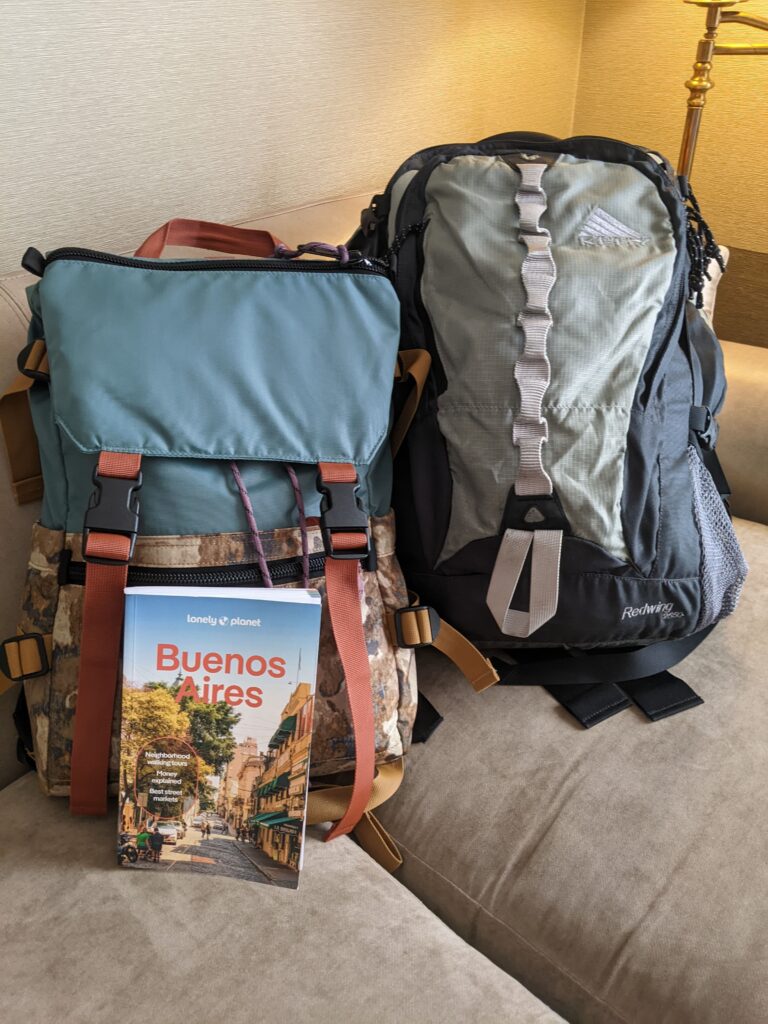
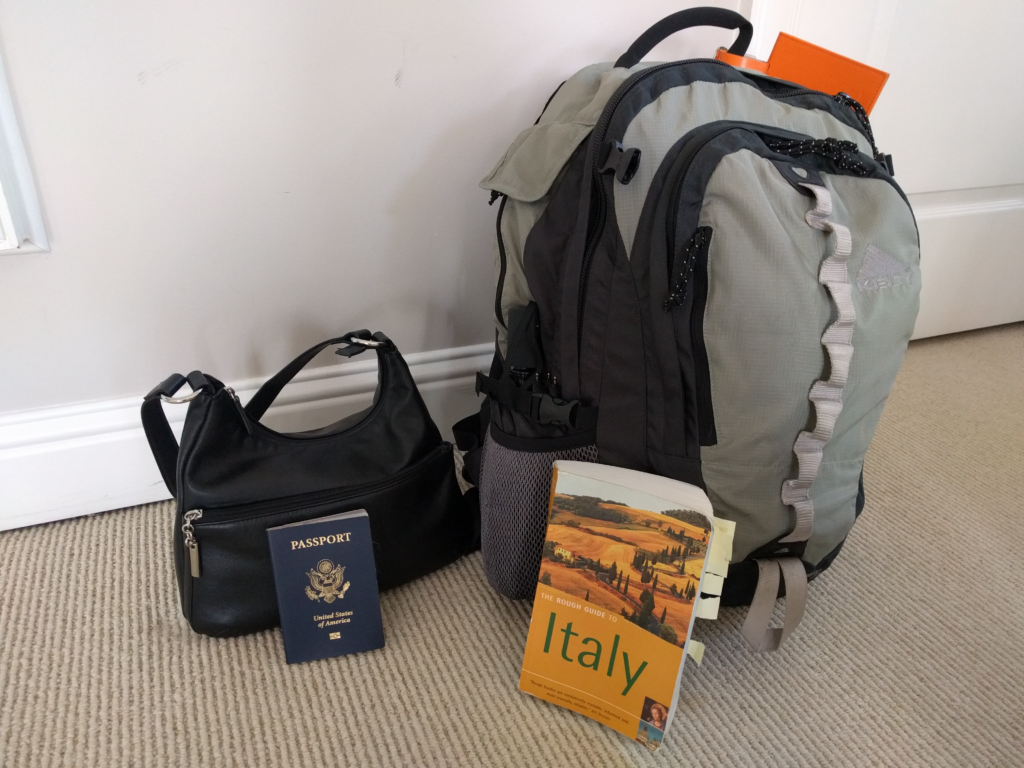
Fun fact:  Chad and I only travel with carry-on luggage; we don’t check bags.  Here’s my bag for the next 2-1/2 months:

Carry-on luggage all the way, baby!

Carry-on luggage all the way, baby!

We’ll do laundry while we’re over there, so we don’t need to take more than a week’s worth of clothes.  We can also buy toothpaste, shampoo and anything else that we need when we’re over there, so we don’t need to take a bunch of stuff with us.  Chad has already found a sporting goods store over there where we can buy a yoga mat and an exercise bolster so we don’t have to haul those things across the ocean.  The only “luxury” items in my luggage are my laptop, Kindle, Italian study notebooks and a book about the history of Molise and Abruzzo.

Stay tuned for news direct from Italy in a couple of days!

Standard
Uncategorized

Language Nerd

So, I’m a bit of a language nerd.  I love learning new languages!  When I was a baby, my mom took me down to Brazil to live with her parents when my dad was drafted to go to Vietnam.  Then again, when I was two years old, my family moved down to Brazil and my dad taught at the American School in Sao Paulo.  As a result, I know toddler Portuguese.

Fast forward to December 1987 when I was a junior in high school.  I mentioned to my parents that I was tired of living in a small town in Missouri and wanted a change of pace.  Two months later, my parents had jobs at the American School in Lisbon, Portugal.  I thought Portugal was in South America, but a consult with an encyclopedia at the local college library cleared things up.

Moving to Lisbon was life-changing.  The cultural experience broadened my horizons in ways that I never imagined.  I made friends from countries around the world.  I got reacquainted with Portuguese, and I learned how to navigate in a foreign country and a foreign language.

And then in college, I was a French major, because, why not learn another language?  As part of my French major, I spent my junior year in Aix-en-Provence, France, and all of my classes were taught in French by professors from the local university.  I still remember the sense of pride that I had when, during my first week in France, I went to the post office and exited with the exactly correct stamps that I needed in order to mail a postcard to my family in the U.S! 

I’m now studying Italian because there’s this Italy trip coming up.  I’ve been studying on and off (mostly off) for seven years, but it’s finally been sticking in my brain.  Chad studied Italian when we were dating in San Francisco, so I’m using his old Italian textbook to study.  The book was published circa 2002, so I’m learning some words that I will never need to know, such as “chalkboard” (lavagna, pronounced like “lasagna”) and “chalk” (which is the word “gesso” that I think a lot of us learned in elementary school art class). 

But I have also learned important words like:

  • Hello – ciao
  • Good morning – buon giorno
  • Good afternoon – buona tarde
  • Good evening – buona notte
  • Please – per favore
  • Thank you – grazie
  • A beer please – una birra per favore
  • A white wine – uno vino bianco
  • A red wine – uno vino rosso
  • a water – una aqua (frizzante is sparkling, naturale is still/tap)
  • Can I get the check – il conto per favore
  • Where is the bathroom – dov’e i servizi (but we now know that there might be another version of this, dialects and all)

We’ll be staying in a small town in Italy, and I have a  hunch that few people will speak English.  I’m hoping that I will get lots of opportunities to practice my language skills and impress people with my antique vocabulary words like “lavagna” and “gesso.”

Standard
Uncategorized

A (Very Brief) History of Italy

Italy, as we know it today, became a country in the 1860s.  I know!  I’ve always thought that Italy was its own country for many, many centuries.  But no.  Before the 1860s, it was a mix of kingdoms, city-states, ducal estates, and misc agrarian areas and, of course, the Papal States (The Pope’s Country).  Italy was “unified,” so to speak, during the 1860s during a period called Il Risorgimento (roughly translates to “The Resurgence” in English) which was a period of civil war for several years.

Part of what contributed to the many separate political entities was the fact there is a vast mountain range that goes down the center of the peninsula, the Appenines range.  This mountain range made it difficult to travel across the country from one coast to the other for many centuries.  In fact, there was a time when it was faster/easier to go via boat from Rome on the west coast to cities on the east coast, traveling around the bottom of the peninsula.  In a car today, the trip across the country takes 3-4 hours via highway.

Chad’s great-grandparents grew up in one of these mountain towns called Monteferrante, and we’ve been there a couple of times to visit relatives.

grandparents emigrated to the U.S. from this village in the Appenine mountains

Monteferrante – a three-hour drive east of Rome, Chad’s great-grandparents emigrated to the U.S. from this village in the Appenine mountains

The rugged terrain also means that many villages were isolated from each other.  It wasn’t uncommon for villages to be a couple of miles apart and for the people to never meet each other.  This is also the reason that there are so many local dialects of the Italian language.  People lived within their own communities for generations, and the language evolved over time.  As result, when you travel around the country, you might encounter multiple words for the same thing.  For example, these words all mean “boy” in Italian:  ragazzo, ragasol, putel, pischello, putlet, piliso, pizzinnu, piccioccu, picciriddu, garsun, fante, magatel, begalt, redesoot, toso, butel, mulo, fioo, and frut.

And here’s another view from Monteferrante, looking over the adjacent valley at night.  You can see lights from nearby villages below:

View from Monteferrante looking down at the valley below

View from Monteferrante looking down at the valley below

The rest of the geography and climate of the peninsula also contributed to the development of different parts of Italy.  The north has more vegetation and lakes and rivers and is more conducive to raising livestock.  The south is warmer and more arid.  If you think about this, it makes sense that, historically, the cuisine in the north has more meat and is cooked more frequently with butter (which is an animal product), and the cuisine in the south is more vegetable-based and uses olive oil as a staple ingredient. 

And now the obligatory food photos from our last trip to Italy because, well, Italy:

Chad went foraging for mushrooms with cousin Antonino

Chad went foraging for mushrooms with cousin Antonino


Speaking of foraging, wild blackberries where in season when we were last there

Speaking of foraging, wild blackberries were in season when we were last there


These cheese-bread dumplings are served with tomato sauce and are a specialty of Chad's ancestral region - I thought I died and went to heaven

These cheese-bread dumplings are served with tomato sauce and are a specialty of Chad’s ancestral region – I thought I died and went to heaven


...AND the obligatory meat and cheese plate photo

…AND the obligatory meat and cheese plate photo

If you want to learn more about Italian history, I recommend the book The Pursuit of Italy by David Gilmour (can be found on Amazon).  The author dives into everything from food to geography to politics to language to arts and architecture.  I’m now reading it for the third time.  (It’s that good!)


Standard